What is the building code for waterproofing in Tampa, Florida?
Tampa AquaBarrier Solutions
Updated May 2026
Florida Building Code Chapter 15 and Hillsborough County Building Services rules govern every waterproofing project in Tampa, determining when a permit is required, which materials qualify, and who is legally allowed to do the work.
Quick Answer
Roof waterproofing in Tampa is governed primarily by Florida Building Code (FBC) Chapter 15, which sets minimum standards for materials, installation methods, and structural performance. Hillsborough County Building Services enforces these standards locally and adds county-level amendments, including specific permit fee schedules and inspection requirements that apply to all roofing and waterproofing work within unincorporated Hillsborough County and the City of Tampa.
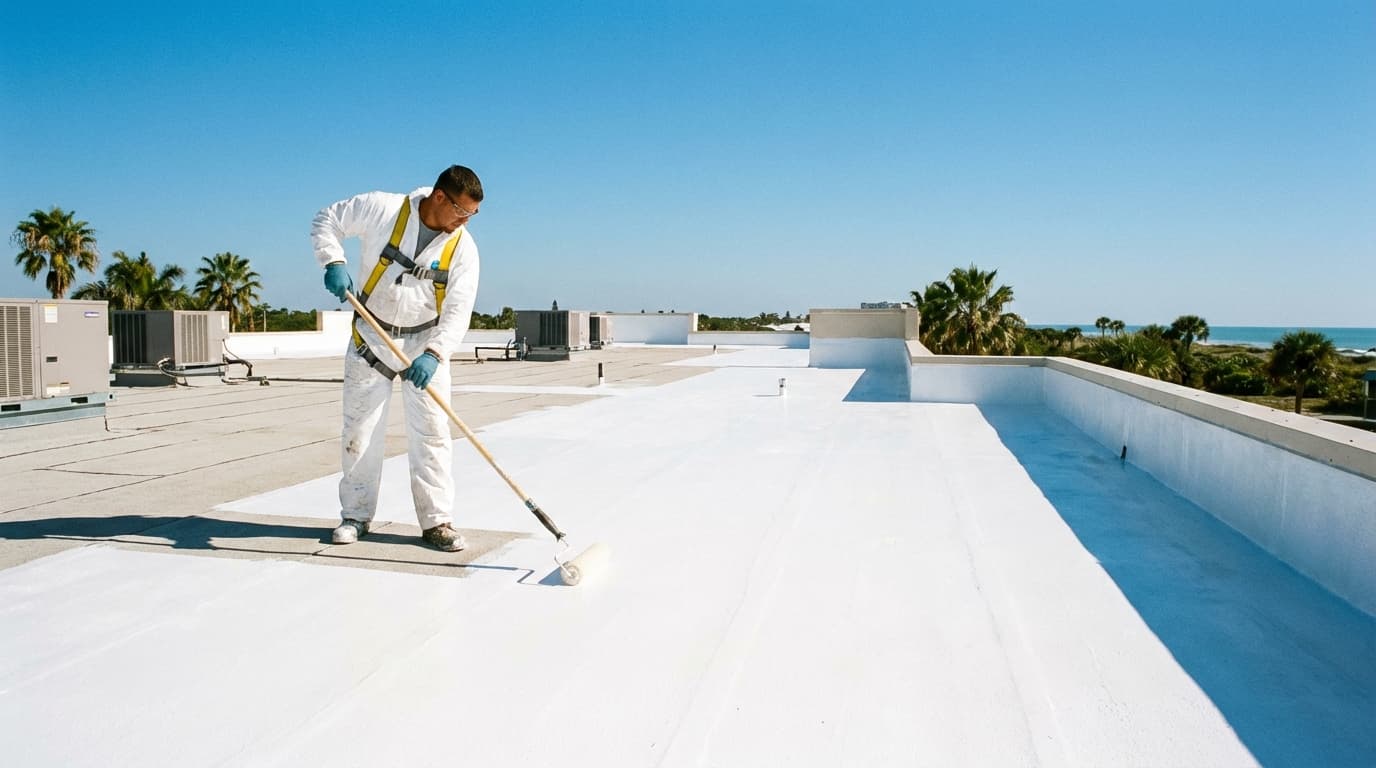
The code distinguishes between maintenance-level work (such as applying an elastomeric coating to an intact surface) and assembly-level work (such as installing or replacing a membrane system). The former typically does not require a permit; the latter does. Any contractor performing permitted work must hold a valid Florida DBPR Certified Roofing Contractor license with a CCC prefix, which confirms they have met the state's bonding, insurance, and competency requirements.
Key Takeaways
Florida Building Code Chapter 15 is the primary code governing all Tampa waterproofing work, enforced locally by Hillsborough County Building Services.
Membrane system installation and replacement require a Hillsborough County permit; elastomeric coating over intact surfaces typically does not.
All permitted waterproofing work must be performed by a Florida DBPR Certified Roofing Contractor (CCC license).
Unpermitted work that required a permit can result in stop-work orders, penalties, and mandatory removal of non-compliant installations.
A final county inspection creates a public record of code-compliant work, protecting homeowners during insurance claims and property sales.
Florida Building CodeChapter 15Hillsborough County Building ServicesDBPRCCC LicenseTPO MembraneEPDM MembraneElastomeric CoatingASTM StandardsWind Uplift RatingFire ClassificationOwner-Builder ExemptionStop-Work OrderCertificate of CompletionPermit Inspection
The short answer
Florida Building Code Chapter 15 is the governing standard for all Tampa waterproofing work, enforced by Hillsborough County Building Services.
Membrane installations and replacements require a permit; elastomeric coatings on intact surfaces typically do not.
Only DBPR Certified Roofing Contractors (CCC license) may perform permitted waterproofing work in Tampa.
Materials must meet ASTM standards for wind uplift and fire classification per FBC Chapter 15.
Skipping a required permit risks stop-work orders, penalties, and insurance claim denials on future damage.
What does Florida Building Code Chapter 15 actually require for waterproofing in Tampa?
Florida Building Code Chapter 15 sets out the minimum performance requirements for all roof assemblies in the state, including waterproofing systems. For Tampa specifically, the code requires that any membrane system (TPO, EPDM, modified bitumen, or built-up) meet minimum wind uplift resistance ratings appropriate for the wind zone, which for Hillsborough County falls under the High-Velocity Hurricane Zone provisions when applicable to coastal proximity. Materials must meet ASTM testing standards appropriate to their classification, including ASTM D4637 for EPDM, ASTM D6878 for TPO, and related standards for modified bitumen systems. The code also requires that all penetrations through membrane systems, such as HVAC curbs, skylights, and drain flanges, be flashed according to the membrane manufacturer's published details and the code's flashing requirements.
Chapter 15 further requires that roof systems in Florida be installed to resist both water intrusion and wind-driven rain, which in Tampa's context means the code is designed for a climate that regularly produces tropical-strength rain events. The Hillsborough County Building Services department enforces these requirements through the permit and inspection process. Confirm these standards through the Florida DBPR and Hillsborough County Building Services before beginning any permitted scope, as the code is updated in each adoption cycle and local amendments may apply to specific property types or locations within the county.
When does a Tampa waterproofing project require a Hillsborough County permit?
The permit threshold in Tampa waterproofing projects comes down to whether the work modifies the roof assembly rather than simply maintaining the surface layer. Applying an elastomeric roof coating over an existing, structurally intact surface falls into the maintenance category and is generally exempt from permit requirements. Replacing an existing membrane system, installing a new membrane on a surface that previously used a different waterproofing method, repairing or replacing roof deck sheathing, or modifying the drainage configuration all constitute changes to the roof assembly and require a Hillsborough County Building Services permit before work begins. The general rule applied by county inspectors is that if the work would affect the structural performance, fire rating, or wind uplift compliance of the roof, a permit is required.
Permit fees for residential waterproofing scopes in Hillsborough County typically range from $150 to $450 depending on project valuation, and the process involves submitting a permit application, waiting for plan review (which can often be same-day for straightforward residential scopes), scheduling a rough-in inspection if decking work is involved, and completing with a final inspection from a county building inspector. AquaBarrier (DBPR License CCC1334952) handles the full permitting process as part of every project, so homeowners do not need to navigate the county system independently. For projects in the City of Tampa itself (as opposed to unincorporated Hillsborough County), permits are issued through the City of Tampa Permitting and Zoning department rather than the county, though the underlying Florida Building Code requirements are identical.
Why must a licensed DBPR contractor perform permitted waterproofing work in Tampa?
Florida Statute requires that any contractor performing roofing or waterproofing work for compensation on a structure they do not own must hold a valid DBPR Certified Roofing Contractor (CCC) license. This requirement applies directly in Tampa, and Hillsborough County Building Services will not issue a roofing or waterproofing permit to an unlicensed person or company. The DBPR license process verifies that the contractor has passed a state examination, carries minimum liability insurance and workers' compensation coverage, and has satisfied the bonding requirements set by the state licensing board. These requirements exist specifically to protect Tampa homeowners from unlicensed operators who may lack both the technical competency and the financial responsibility to back their work.
The practical implication for Tampa homeowners is straightforward: before signing any waterproofing contract, verify the contractor's CCC license number through the Florida DBPR online verification portal. A legitimate contractor will provide this number without hesitation. AquaBarrier's license number is CCC1334952 and can be verified through the Florida DBPR portal at any time. Using an unlicensed contractor for a permitted scope means the permit cannot legally be pulled under that contractor's name, which typically results in the work proceeding without a permit, creating all the complications that come with unpermitted work including insurance claim exposure and potential legal liability for the homeowner.
What material standards does Florida Building Code require for Tampa waterproofing systems?
Florida Building Code Chapter 15 requires that waterproofing materials used in Tampa meet specific ASTM testing standards before they can be installed in a code-compliant project. For single-ply membranes, TPO systems must comply with ASTM D6878 (thermoplastic polyolefin-based sheet roofing), while EPDM systems must meet ASTM D4637 (vulcanized rubber sheet roofing). Elastomeric coatings intended for use as primary waterproofing must meet ASTM D6083 for acrylic coatings or equivalent standards for silicone and urethane formulations. Beyond material standards, the code requires that every system be installed to meet the minimum wind uplift resistance for the applicable wind zone. In most of Hillsborough County, this means compliance with ASCE 7 wind load provisions for the applicable risk category.
Fire classification is a second material requirement that affects product selection. Florida Building Code requires that roof assemblies meet Class A, B, or C fire ratings depending on the structure's occupancy and construction type. Most residential roofing applications require a minimum Class C assembly, with many newer products meeting Class A. When selecting a waterproofing system for a Tampa home, confirm that the manufacturer's product documentation includes both the ASTM compliance statement and the fire classification for the system as installed, not just the base material. AquaBarrier uses only products whose technical data sheets confirm compliance with the applicable FBC Chapter 15 material standards, and this documentation is included in the project file for every job.
What are the consequences of unpermitted waterproofing work in Tampa?
Hillsborough County Building Services has enforcement authority over unpermitted construction and roofing work within its jurisdiction. If inspectors discover that waterproofing or roofing work was performed without a required permit, they can issue a stop-work order immediately, require the homeowner to apply retroactively for a permit (with fees that are typically doubled as a penalty), and potentially require that portions of the work be exposed or removed to allow for inspection. In severe cases, a lien may be placed on the property until the code compliance issue is resolved. The Florida DBPR can also take action against licensed contractors who perform permitted work without pulling permits, including suspending or revoking their license.
Beyond direct enforcement consequences, unpermitted waterproofing work creates downstream risk at two critical moments: when a homeowner files an insurance claim, and when a property is sold. Insurers reviewing claims for water-related damage routinely check whether relevant prior work was permitted. If an adjuster determines that unpermitted work contributed to the damage or that the current roof assembly does not comply with code, the claim may be partially or fully denied. At the time of sale, unpermitted work must be disclosed in Florida, and a buyer's inspection will often flag it. Hillsborough County property records show open permits and permit history, so the absence of a permit record for significant roofing work is visible to buyers and their agents.
Can a Tampa homeowner perform their own waterproofing work without a license?
Florida law includes an owner-builder exemption that allows homeowners to perform certain construction work on their own primary residence without holding a contractor license. Under this exemption, a Tampa homeowner can apply for a permit in their own name and perform the waterproofing work themselves, provided the property is their primary residence and they do not intend to sell or lease the property within one year of completion. The exemption comes with a sworn statement requirement and does not eliminate the need for a permit or the required inspections. An owner-builder permit still triggers the same code compliance requirements as a licensed contractor permit, and the homeowner personally assumes liability for code compliance and workmanship.
In practice, the owner-builder exemption for waterproofing is most useful for very limited scopes such as elastomeric recoating, sealant application, and minor flashing repairs. Membrane system installation on flat roofs requires significant skill and specialized equipment, and errors in installation are not immediately visible from the surface. For insured properties, homeowners should verify with their carrier whether owner-performed waterproofing work affects their coverage, as some policies require licensed contractor installation for coverage to apply to the modified portion of the structure. Confirm the current scope of the owner-builder exemption through Florida DBPR before beginning any project under this provision, as the rules have been updated multiple times in recent legislative sessions.
What do Tampa waterproofing code requirements look like by neighborhood?
Properties in South Tampa, particularly those near Bayshore Boulevard and Davis Islands, sit in FEMA flood zones that add an additional layer of compliance to waterproofing projects. Hillsborough County may require elevation certificates for permitted work on properties in Zone AE, and some older South Tampa bungalows have non-standard roof framing that requires structural engineering documentation before a membrane permit is issued.
What do Tampa homeowners ask most about waterproofing code compliance?
Florida Building Code Chapter 15 (Roof Assemblies and Rooftop Structures) governs all waterproofing work on Tampa roofs. Local amendments enforced by Hillsborough County Building Services layer on top of the statewide code. Any work altering a roof assembly, including membrane installation and re-coating over damaged surfaces, must comply with both.
It depends on the scope. Applying an elastomeric coating over an intact, structurally sound surface typically does not require a Hillsborough County permit. Installing or replacing a TPO or EPDM membrane system, repairing decking, or making any structural change to the roof assembly does require a permit from Hillsborough County Building Services.
Florida law requires all roofing contractors, including those installing waterproofing membranes and coatings, to hold a valid DBPR Certified Roofing Contractor license (CCC prefix). Homeowners may perform certain work on their own primary residence under the owner-builder exemption, but licensed contractor work is required for all insured and permitted scopes.
Chapter 15 requires membrane waterproofing systems to meet minimum material standards for wind uplift, fire classification, and water resistance. TPO and EPDM membranes must be installed per manufacturer specifications and tested to ASTM standards. All penetrations through membrane systems require code-approved flashing and sealant details.
A licensed contractor submits plans and a permit application to Hillsborough County Building Services. Permit fees are based on the scope and valuation of the work. After approval, the contractor performs the work and schedules a final inspection. The county inspector verifies code compliance before closing the permit.
Unpermitted work can result in stop-work orders, mandatory removal of non-compliant work, retroactive permit fees with penalties, and complications when selling the property or filing an insurance claim. Hillsborough County Building Services has the authority to require full deconstruction and re-inspection of unpermitted work.
Yes, for permitted scopes. After permitted waterproofing work is complete, a Hillsborough County Building Services inspector must perform a final inspection and issue a certificate of completion. This creates a public record of the compliant repair and protects homeowners in future insurance or sale transactions.
What should Tampa homeowners do in the next five minutes about waterproofing code compliance?
Right now (1 min)
Look up your contractor's DBPR license number at myfloridalicense.com. Enter the CCC number and confirm it is active and in good standing before any contract is signed.
Today (15 min)
Check your property record on the Hillsborough County Property Appraiser site and confirm that any prior roofing permits were properly closed with a final inspection. Open permits create complications for insurance and sales.
This week
Get at least two itemized quotes from licensed contractors. Ask each to specify whether the proposed scope requires a permit and which material system they plan to install, including its ASTM compliance documentation.
Before signing
Confirm with your homeowner's insurance carrier whether the planned waterproofing system affects your policy's coverage terms. Some carriers require licensed contractor installation documentation for full coverage to apply.
For any Tampa waterproofing project, the single most protective step in the next 60 seconds is verifying contractor license status through the Florida DBPR portal before a contract is signed. A valid, active CCC license number is the baseline confirmation that the contractor meets Florida's minimum legal requirements for the work, and it takes less than a minute to check.