How Long Does a Roof Last in Florida? Tampa Bay Homeowner's Guide
Florida's climate shortens roof lifespans significantly compared to national averages. Learn actual lifespan expectations for asphalt, tile, and metal roofs in Tampa Bay — and what extends or shortens them.
The "30-year shingle" label on roofing products is one of the most misleading pieces of information in the building industry — at least for Florida homeowners. That rating is based on testing conditions that don't resemble what roofs face in Tampa Bay.
Understanding realistic lifespan expectations for your roof type is one of the most valuable things you can know as a homeowner. It affects when you should start budgeting for replacement, how to evaluate insurance coverage, and whether a repair or replacement is the right decision when something goes wrong.
Why Florida Roofs Age Faster
Before getting into numbers, it helps to understand why the national averages — which most online guides cite — don't apply here.
UV radiation is the primary accelerant. Tampa receives approximately 2,900 hours of sunshine per year, among the highest in the continental U.S. UV radiation breaks down the asphalt compounds in shingles at a rate roughly 30% to 40% faster than in the northeastern states where many product ratings originate. The result is accelerated granule loss, brittleness, and cracking.
Humidity accelerates biological growth. Tampa's average relative humidity exceeds 70% year-round. This supports algae and lichen growth on roof surfaces, which holds moisture against the material surface. Algae staining is aesthetic; lichen growth actually damages shingle surfaces. Both are routine on Tampa Bay roofs after 5 to 7 years without treatment.
Thermal cycling adds mechanical stress. The combination of hot summer days (95°F+) and occasional near-freezing winter nights means roofing materials expand and contract through a larger range than in more stable climates. Over years, this movement stresses fasteners and sealants at penetrations and transitions.
Hurricane season loads test fastening systems annually. Even moderate tropical systems produce wind speeds and wind-driven rain events that test roof assembly performance. A roof that meets minimum code but was installed with substandard fastening will begin failing at valleys, rakes, and ridges faster than one installed to current standards.
Asphalt Shingle Lifespan in Tampa Bay
National average cited on packaging: 25 to 30 years (architectural/dimensional shingles)
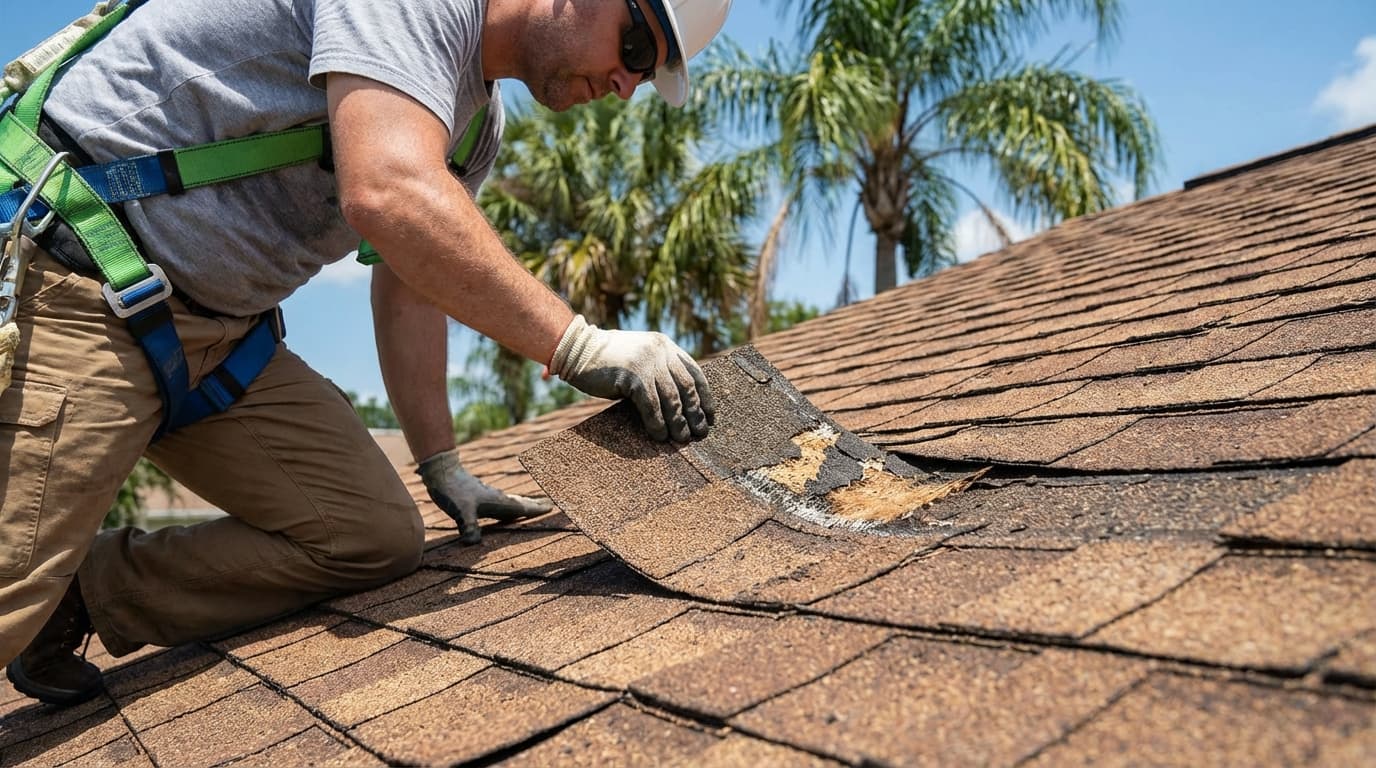
Realistic Florida expectation: 15 to 22 years
The gap between the label and Florida reality is almost entirely explained by UV exposure and humidity cycling. A 30-year architectural shingle installed in Massachusetts will reach 25+ years routinely. The same product installed in Tampa will typically show significant granule loss and cracking by year 15 to 18.
Factors that shorten shingle life in Tampa:
- North-facing slopes age faster due to more sustained moisture retention
- Roofs with heavy tree canopy overhead accumulate debris and hold moisture
- Poor attic ventilation raises deck temperatures, accelerating asphalt breakdown from below
- Installation over existing shingles (recovering rather than tear-off) reduces lifespan by 3 to 5 years
Factors that extend it:
- High-quality dimensional shingles with algae-resistant granules (Scotchgard-treated or equivalent)
- Adequate attic ventilation — every 150 square feet of attic floor area should have 1 square foot of net free ventilation area
- Annual roof cleaning to remove algae and debris accumulation
- Prompt repair of minor damage before water intrusion begins
When to plan for replacement: If your asphalt shingle roof is 12 to 15 years old and you start seeing granule accumulation in gutters, cupping or curling at shingle edges, or bald spots, begin budgeting. A 15-year-old Tampa shingle roof may have 5 to 7 years of service life remaining under good conditions — but it is no longer a "young" roof.
Concrete and Clay Tile Lifespan
National average cited: 40 to 50 years
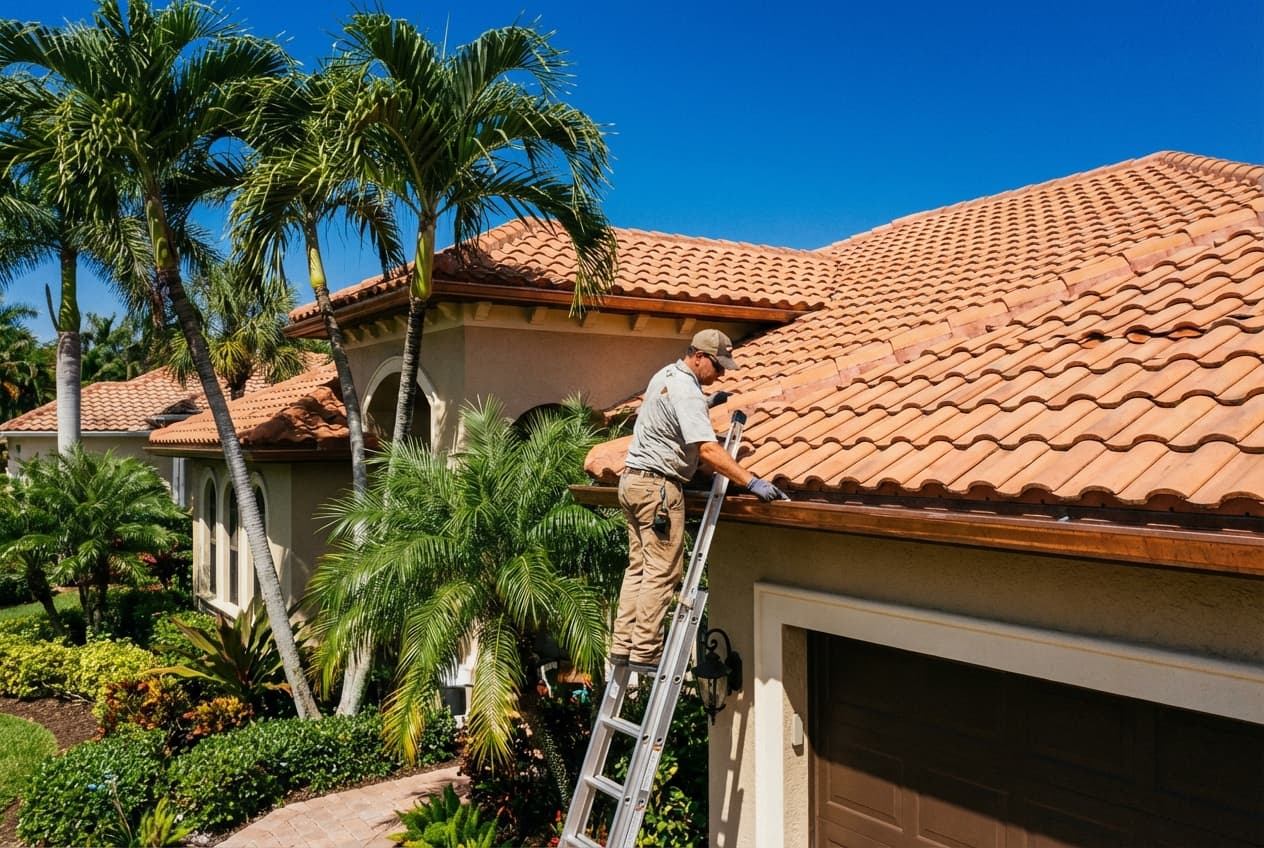
Realistic Florida expectation: Tile surface 40 to 60+ years; underlayment 20 to 30 years
Tile itself is nearly immune to UV degradation because the color is mineral-based, not surface-applied. A concrete tile roof in Tampa Bay will routinely outlast two or three asphalt shingle roofs installed over the same period.
The important distinction is that tile roofing is a two-component system. The tile surface and the underlayment beneath it age at completely different rates. When the underlayment reaches end of life — typically 20 to 25 years — the tile must be removed, the underlayment replaced, and the tile reset. The tile itself is often reusable.
Underlayment replacement is a significant cost (typically $6,000 to $15,000 depending on roof size and tile reuse rate) but is not the same as full roof replacement. Understanding this distinction matters when budgeting.
Signs the underlayment needs attention before the tile looks bad:
- Interior staining at multiple locations after rain
- Mold or mildew smell in attic spaces under tile areas
- Tile that sounds hollow when tapped (underlayment has separated)
Factors specific to tile in Florida:
- Hurricane impact can crack individual tiles without affecting the system — cracked tiles should be replaced promptly to prevent underlayment exposure
- Moss and algae growth in the grooves between tiles is cosmetic but retains moisture; annual cleaning recommended
- Walking on tile without proper support boards causes cracking — hire professionals for any roof access
Metal Roof Lifespan
National average cited: 40 to 70 years
Realistic Florida expectation: 35 to 60 years depending on metal type and coating
Metal roofing performs extremely well in Florida's climate when the right material is specified. The main variable is corrosion resistance.
Aluminum: Naturally corrosion-resistant, does not require protective coating to resist Florida humidity and salt air. Appropriate for coastal and near-coastal Tampa Bay properties. Lifespan 40+ years.
Galvalume steel: Zinc-aluminum alloy coating provides excellent corrosion resistance in most applications. Standard for Florida metal roofing. Lifespan 35 to 50 years.
Bare galvanized steel: Not appropriate for Tampa Bay. Zinc coating alone does not provide sufficient protection in coastal humidity environments.
Standing seam vs. exposed fastener: Standing seam systems with concealed fasteners have fewer corrosion entry points and better wind uplift resistance. Exposed fastener systems have neoprene washers that degrade over 15 to 20 years and require inspection and replacement.
What extends metal roof life in Florida:
- Quality Kynar/PVDF coating systems maintain reflectivity and resist chalking far longer than polyester coatings
- Proper substrate — metal needs ventilated space below to prevent condensation on the underside
- Prompt attention to any coating damage, cut edges, or fastener issues that expose raw metal
Flat and Low-Slope Roofing Lifespan
TPO membrane: 15 to 25 years in Florida conditions. Heat-welded seams hold well in UV exposure; inspect seams and penetrations annually.
Modified bitumen: 20 to 30 years. More impact resistant than TPO, handles foot traffic better. Granule-surfaced cap sheets resist UV reasonably well.
SPF (Spray foam): The foam base itself is durable, but the elastomeric coating that protects it needs recoating every 10 to 15 years. With proper maintenance, the system can last 30+ years.
Flat roofing in Florida requires more frequent inspection than pitched roofing. Standing water accelerates membrane degradation significantly — proper drainage design is critical to achieving full service life.
Practical Decision Guide: Repair or Replace?
The lifespan numbers above support a straightforward framework:
| Roof Age | Recommended Action |
|---|---|
| Under 10 years | Repair unless damage is catastrophic |
| 10–15 years (asphalt) | Repair if damage is isolated; assess overall condition |
| 15+ years (asphalt) | Full inspection; consider replacement if widespread wear |
| 20–25 years (tile) | Assess underlayment; likely approaching replacement window |
| 25+ years (any type) | Full professional assessment; budget for replacement |
The cost-effectiveness of repair declines as the roof ages. A $600 repair on a 7-year-old roof makes economic sense. The same repair on a 20-year-old asphalt roof buys you limited additional service life.
Getting an Honest Assessment
The challenge with roof age assessments is that condition varies significantly based on installation quality, maintenance history, and local exposure factors. A 14-year-old roof on a well-ventilated home with minimal tree cover may be in better condition than a 10-year-old roof over a poorly-ventilated attic under heavy canopy.
Our free 25-point inspection gives you a documented assessment of actual condition — not just age — so you can make an informed decision about timing. We'll tell you honestly if a roof has several years left, and we'll tell you honestly when the economics of further repair no longer make sense.
Call (813) 324-6813 to schedule yours. No obligation, no pressure.