Free Inspections · Licensed & Insured
For Tampa homeowners, property managers, and real estate investors evaluating gutters that have reached the 20-year mark, this page covers the inspection criteria, cost comparison, and timing factors that should drive the replacement decision in Hillsborough County.
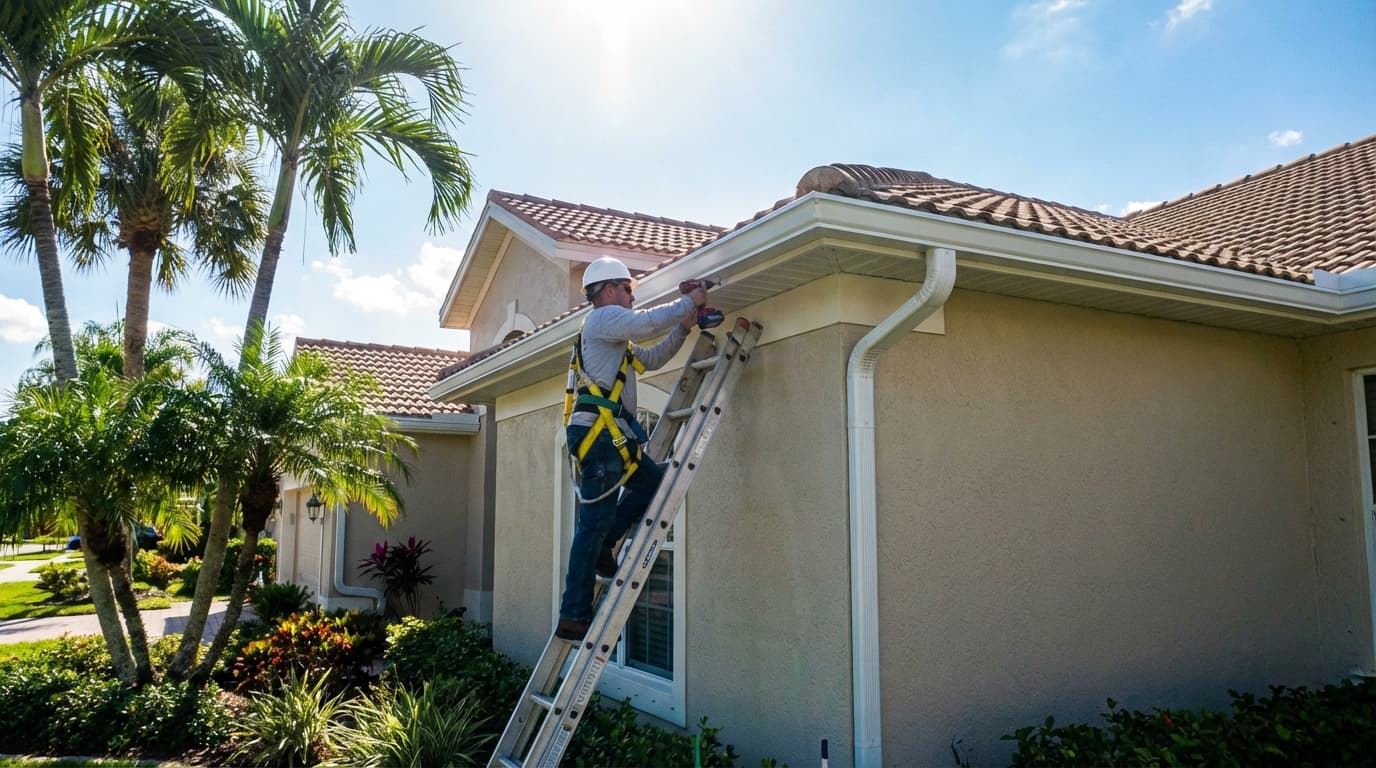
In Tampa, Florida, 20-year-old gutters are at or near the end of their expected service life and replacement is typically the right call when they show two or more signs of deterioration. Aluminum gutters in Hillsborough County last 15 to 25 years under normal conditions, but Florida's combination of annual hurricane-season stress, high UV exposure, and persistent humidity accelerates material fatigue compared to cooler markets. A 20-year gutter that still functions without visible failure signs can often go a few more seasons with maintenance; one that is pulling away from the fascia, rusting at the hardware, or causing water stains on fascia boards should be replaced before the next storm season begins.
The financial argument for proactive replacement at 20 years is straightforward. Piecemeal repair on aging gutters in Tampa commonly runs $100 to $300 per section and buys limited additional life because the surrounding material is equally fatigued. A full seamless aluminum replacement typically costs $900 to $1,800 for a standard single-story Tampa home and resets the maintenance clock for another 15 to 25 years. Delayed replacement that allows water to penetrate behind failing gutters into the fascia adds $8 to $20 per linear foot in fascia replacement cost on top of the gutter price, making the math for early action better than it initially appears.
The expected service life for aluminum gutters in Tampa sits between 15 and 25 years, which places 20-year-old systems squarely in the decision zone where the condition of the specific installation matters more than the age alone. Gutters installed by a skilled contractor using 0.027-inch or 0.032-inch gauge aluminum, properly spaced hangers, and high-quality sealant at all joints may still be performing well at 20 years. Gutters installed with thinner gauge material, inadequate hanger spacing, or lower-quality sealant are commonly showing meaningful deterioration by year 15 in Hillsborough County's environment. The honest answer to whether replacement is warranted is that age alone is not sufficient: a systematic inspection using the criteria below is necessary to make a well-founded decision.
What is unambiguously true is that gutters that have reached 20 years in Tampa have absorbed roughly 1,000 to 1,200 inches of cumulative rainfall, experienced two decades of annual hurricane-season wind loads, and weathered 20 Florida summers of UV intensity that is among the highest in the continental United States. Even well-installed systems are carrying meaningful material fatigue at this point, and the probability of at least one failure point developing in the next storm season increases substantially past the 20-year mark. Scheduling a professional inspection now, before any symptoms become visible from the ground, is the appropriate step for a Tampa homeowner at this stage in a gutter system's life.
Six observable conditions on 20-year-old Tampa gutters reliably indicate that replacement is the more cost-effective path versus continued repair. First, sections that are pulling away from the fascia board are signaling either hanger failure from corrosion or fascia rot that can no longer hold a fastener, both of which require addressing the substrate before any repair of the gutter itself is meaningful. Second, orange or brown rust staining on aluminum gutters indicates that steel fasteners or brackets inside the system have corroded, a process that accelerates as the system ages and is not reversible through surface cleaning alone. Third, visible cracks or splits in the gutter channel, particularly at corners and end caps where sealant has dried and contracted over 20 Florida summers, are points of active water intrusion that will worsen with each storm event.
Fourth, water stains or paint peeling on the fascia board directly behind the gutters indicates that water has been running behind the gutter lip rather than into the channel, which means the system is no longer properly pitched or the gutter profile has deformed enough to allow overflow. Fifth, standing water visible in the gutter channel hours after a rain event indicates that the slope has been lost, commonly from hanger failure causing the channel to sag at mid-run. Sixth, downspout separation at joints, particularly at the elbow connections between the vertical drop and the foundation extension, indicates that sealant has failed and the joint is leaking at the foundation level, exactly the location where water intrusion causes the most damage in FEMA flood-zone properties. Two or more of these conditions present simultaneously on a 20-year-old Tampa system makes replacement the clear financial choice.
Individual repairs on aging Tampa gutter systems typically run $75 to $300 per section depending on the scope: resetting a pulling section with new hangers costs $75 to $150, resealing all joints on a full home runs $150 to $300, and replacing a damaged end cap or corner piece is commonly $50 to $100 per unit. The aggregate repair cost for a 20-year-old Tampa home that needs multiple sections addressed often lands in the $400 to $800 range for a full catch-up repair visit, and that work does not address the underlying material fatigue in adjacent sections that haven't yet failed visibly but are approaching the same point.
A full replacement with new seamless aluminum gutters typically costs $900 to $1,800 for a single-story Tampa home at current market pricing, and $1,500 to $2,500 for a two-story home. The replacement resets the maintenance expectation to another 15 to 25 years rather than buying two to five additional years of uncertain performance from an aging system. The comparison becomes even clearer when fascia damage is factored in: every year that failing gutters allow water to run behind the channel into the fascia adds fascia rot that costs $8 to $20 per linear foot to address at replacement time. A homeowner who defers replacement for three additional seasons while doing annual repairs may spend $1,200 to $2,400 in combined repair and fascia costs on top of the eventual replacement price.
The optimal window for gutter replacement in Tampa is February through May, before the June-to-September peak storm season begins. This timing allows sealant and hardware to cure fully under dry conditions before the system faces its first heavy loading event, and it gives any fascia replacement work time to be completed and inspected without the pressure of impending storm deadlines. Contractor availability is also generally better in the late winter and early spring window than it is after hurricane damage events in October and November drive a demand spike across Hillsborough County.
Homeowners who discover failing gutters during the storm season face a more urgent calculation. Gutters that are actively overflowing, pulling from the fascia, or allowing water to reach the foundation on a FEMA-designated flood zone property should be addressed immediately rather than waiting for the pre-season window. The City of Tampa Construction Services and Hillsborough County Building Services both process residential permit applications on a rolling basis, so permit-required work does not need to wait for any particular calendar period. FEMA guidance for flood-risk properties treats foundation drainage as a mitigation priority, and a licensed Tampa contractor can typically assess a failing system and provide a replacement timeline within 48 hours of an initial inspection.
A systematic inspection of 20-year-old gutters in Tampa takes about 30 minutes and produces the information needed to make a confident replacement versus repair decision. Start by walking the full roofline perimeter during or immediately after a significant rainstorm, which is the only reliable way to observe active overflow, leaks at joints, and downspout separation under actual load conditions. Note any locations where water is running over the gutter lip rather than into the channel, any joints where water is visibly dripping rather than flowing into the downspout, and any downspout connections that are separated or leaking at the elbow.
After the rain event, press a screwdriver firmly into the fascia board at 10-foot intervals along the full roofline. Any soft or spongy response indicates rot has already progressed into the wood, meaning that section of fascia must be replaced before new gutters can be properly anchored. Check hanger positions along each run for sections where the gutter channel has sagged below the adjacent sections, indicating hanger failure. Look for visible rust staining below any hanger or screw point, which indicates corrosion inside the system. Document all findings with photos and share them with any contractor you ask to bid, so each bidder is assessing the same condition information rather than conducting their own independent scope visit that may miss subtler failure points.
| # | Factor | Repair signal | Replace signal | Time to assess |
|---|---|---|---|---|
| 1 | Sections pulling from fascia | One isolated section | Two or more sections | On site |
| 2 | Fascia condition behind gutters | Solid wood, passes screwdriver test | Soft or spongy, rot present | On site |
| 3 | Joint sealant failure | One or two joints leaking | Multiple joints failed | On site |
| 4 | Overflow during rain | One run overflowing, others fine | Multiple runs overflowing | On site |
| 5 | Rust staining on aluminum | One bracket location | Three or more locations | 5 min |
| 6 | Downspout separation | One joint separated | Multiple outlets compromised | 5 min |
| 7 | Channel sagging | One mid-run sag, hangers accessible | Multiple sags, hangers failing throughout | On site |
| 8 | Gutter gauge | 0.027 or 0.032 confirmed | Unknown or likely undersized | 5 min |
| 9 | Prior repair history | One repair in past 5 years | Multiple repairs, increasing frequency | Under 1 min |
| 10 | FEMA flood zone property | Low-risk zone, no drainage concerns | Flood zone, foundation drainage critical | Under 1 min |
South Tampa homes built in the 1950s and 1960s that still have original wood fascia behind 20-year-old gutters face a compound problem: the gutters have absorbed 20 years of Florida stress on top of already-aging underlying wood. Fascia replacement rates in this area during gutter replacement projects are among the highest of any Tampa neighborhood. Homeowners planning replacement here should budget for fascia replacement on at least a portion of the roofline and should request a fascia inspection before any contractor provides a fixed-price bid.
Aluminum gutters in Tampa typically last 15 to 25 years under normal conditions. Florida's combination of high annual rainfall, hurricane-season wind loads, UV intensity, and salt-influenced air accelerates wear compared to cooler, drier climates. Gutters that have reached 20 years are operating at or near the end of their design life in Tampa, making inspection and proactive replacement planning appropriate.
Key replacement indicators for 20-year-old Tampa gutters include: visible rust or orange staining on aluminum (caused by corroding hardware rather than the aluminum itself), sections pulling away from the fascia, peeling paint or water stains on fascia boards directly behind the gutters, pooling water in the gutter channel during rain, and downspout separation at joints. Any of these conditions on gutters that have reached 20 years strongly suggests replacement over repair.
For gutters that have reached 20 years in Tampa, replacement is usually more cost-effective than repair when two or more sections show failure symptoms. Individual repairs on aging systems commonly run $100 to $300 per section and address the symptom without resolving the underlying material fatigue. A full replacement with new seamless aluminum typically runs $900 to $1,800 for a single-story home and resets the maintenance clock for another 15 to 25 years.
Waiting an additional season on gutters that are already showing failure symptoms in Tampa carries meaningful risk. Water intrusion behind failing gutters damages fascia boards at $8 to $20 per linear foot to replace, and can extend to soffit and wall cavity damage that costs considerably more to address. Scheduling replacement before the June-to-September peak rainfall season eliminates the risk of a high-cost failure during the period when Tampa gutters face maximum stress.
Standard gutter-for-gutter replacement typically does not require a permit in Tampa, but if the 20-year-old fascia behind the gutters is rotted and needs replacement, that work triggers permit requirements under the Florida Building Code. Hillsborough County Building Services and the City of Tampa Construction Services both require permits for structural fascia work, so confirm the scope and permit status with your contractor before work begins.
Homeowners in FEMA-designated flood zones in Hillsborough County should treat deteriorating gutters as a higher-priority item than those in low-risk areas, because inadequate drainage contributes to foundation flooding during high-rainfall events. Replacing 20-year-old gutters with a correctly sized and sloped system, including downspout extensions that carry water at least 4 to 6 feet from the foundation, directly reduces flood risk from surface drainage and is consistent with FEMA mitigation guidance.
Look for a DBPR-licensed Florida roofing contractor with documented experience in Hillsborough County, current general liability and workers compensation insurance, and a written bid that specifies material gauge, seamless or sectional system, hanger spacing, downspout count, and fascia inspection scope. Ask specifically whether the contractor will inspect the fascia condition before hanging new gutters, as this step is the most common differentiator between a quality installation and one that will fail prematurely.
Walk the roofline perimeter and count how many of the six failure signs (pulling from fascia, rust staining, cracks, overflow, sagging, downspout separation) are present. Two or more is the threshold that makes replacement the financially sound choice.
Press a screwdriver firmly into the fascia board at several points behind the gutters. Soft or spongy wood means fascia rot is already underway, which makes immediate replacement more urgent and confirms that every additional season of delay adds fascia replacement cost to the project.
Check whether your property falls in a FEMA flood zone by entering your address at the FEMA Flood Map Service Center. Properties in Special Flood Hazard Areas should treat failing gutters as a drainage priority, not a cosmetic concern, and replacement should be scheduled before the next storm season begins.
Contact a DBPR-licensed Tampa gutter contractor for a written inspection report and replacement quote. Request that the quote itemize gutters separately from fascia work and confirm whether the scope will require a permit from Hillsborough County Building Services or the City of Tampa Construction Services.
Twenty-year-old gutters in Tampa, Florida are at a decision point that rewards proactive action over deferred maintenance. The combination of Florida's environmental stress on aluminum systems, the compounding cost of fascia damage when replacement is delayed, and the risk of failure during peak storm season all point toward scheduling a professional inspection now and a replacement before June if two or more failure signs are present. The fastest available step is walking the roofline perimeter today, pressing the fascia, and using what is found to brief two DBPR-licensed Tampa contractors for written bids that clearly separate gutter and fascia scope.
Get an inspection-first estimate from a licensed Tampa contractor who will assess fascia condition, scope the project correctly, and meet Florida Building Code requirements.
(813) 324-6813